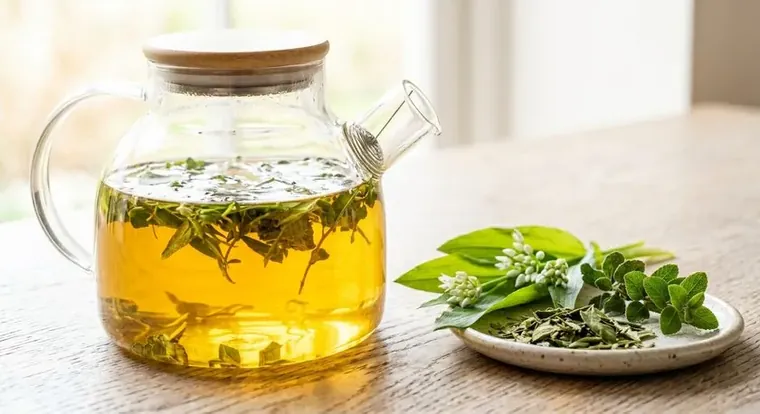
Eight plants, one living tradition — still practiced exactly as it has been for generations.
Long before "wellness" became an industry, indigenous South African medicinal plants were quietly doing the work — African wormwood for the chest, buchu for the kidneys, honeybush for the nerves, each refined by generations of use rather than a marketing department. Here's an honest field guide to eight of the plants at the center of that tradition.
Known locally as wilde als, African wormwood is one of the most widely used indigenous plants on the continent, traditionally prepared as a steam inhalation or infusion for chest and respiratory complaints. It grows across a huge range — from the Cape to tropical Africa — which partly explains how deeply it's woven into so many different regional traditions at once.
Buchu's small, oil-rich leaves carry a distinctive blackcurrant-like scent, and its traditional use as a kidney and urinary tonic predates written South African history. Early Cape settlers adopted it directly from Khoi communities, and buchu-brandy tonics were a fixture of Cape households for generations afterward — one of the clearer examples of indigenous knowledge shaping settler culture, not the other way around.
Often mentioned alongside its more famous cousin rooibos, honeybush is a fynbos plant fermented in a strikingly similar way — cut, bruised, and left to oxidise in the sun until it turns a deep amber. Unlike rooibos, honeybush contains naturally occurring plant compounds structurally similar to those studied in soy, which has made it a subject of growing scientific interest in recent years.
The baobab tree can live well over a thousand years, and its fruit — a dry, powdery pulp rather than the juicy interior most fruit has — has been part of traditional diets across the continent for just as long. Local names for the baobab often translate roughly to "tree of life," a fairly accurate description for a species that provides food, fibre, and shelter from a single trunk.
Named for the small, hooked barbs on its fruit, devil's claw is native to the Kalahari region shared by South Africa, Namibia, and Botswana. The San and Khoi peoples used its tuberous root for centuries before European colonists encountered it in the early 1900s and brought it back to Europe, where it became — and remains — one of the most widely used herbal imports from Southern Africa.
Sometimes called the "miracle tree," moringa isn't originally native to Southern Africa — it likely arrived via historic Indian Ocean trade routes — but it has been thoroughly adopted into local traditional practice over generations. Nearly every part of the tree is used: leaves, pods, seeds, and root, which is part of why it's spread so widely across the continent's herbal traditions.
Unlike the more commercially familiar Aloe Vera, Aloe Ferox grows wild across the Western and Eastern Cape rather than on cultivated farms, and South African communities have worked with it for generations. Its bitter sap is harvested by hand in a technique that has barely changed in over a century.
Despite the name, African potato isn't related to the potato at all — it's a member of the lily family, identifiable by its bright yellow, star-shaped flowers, which is where its traditional name "star lily" comes from. Its underground corm has long been used as a general tonic, particularly during recovery and convalescence.
What's notable about all eight of these plants is that none of them are relics — every one is still in active, everyday traditional use today, exactly as it was generations ago. That continuity is rare, and it's the entire reason EarthTrace exists: to document these traditions properly, rather than let them fade into footnotes.
If this is your first look into indigenous South African medicinal plants, our free introductory ebook, The First Step, is a genuinely useful place to start — a short, no-cost guide to the history and philosophy behind this tradition, with no obligation beyond curiosity. For anyone ready to go deeper, our six full guides document complete traditional protocols built around specific plants like these, from daily immune support to skin, stress, and recovery.
Further reading: Wikipedia: Artemisia afra · Wikipedia: Harpagophytum
This article shares traditional and ancestral wellness knowledge for educational purposes only. It is not medical advice and is not a substitute for consultation with a qualified healthcare professional. Read our full disclaimer.